


Petroleum Trends International, Inc. – Publishers of JobbersWorld
March 15, 2024
It’s common to hear the names of RelaDyne, Brenntag, Moove, Cadence, Parkland, Parman, Offen, McPherson, and a few others mentioned when people talk about the big distributors in the US lubricants business. But, while most in the industry are aware that these are the heavy hitters, how they got there is not as well known.
JobbersWorld’s series on Titans in Lubricants Distribution provide insights into how the titans in got to where they are today. While the paths taken by each are different, what several have in common are the benefits that come with acquiring up and running companies whose owners put it all on the line. They, and often generations before them, already invested capital in buildings, tanks, inventory, equipment and trucks, and hired employees, took and managed risks, and made sacrifices to build a book of profitable business. These titans gained from, and built on the decades of experience and blood, sweat and tears of the many hard-working managers, sales reps, administrative staff, warehouse workers, drivers, and others that came with acquisitions.
The story are real eye-openers when you consider the number of companies that have been acquired and the collective number of years of experience embodied in the acquisitions that underpin their growth and success. It’s also mindboggling to think about the amount of time and money these companies invested in identifying acquisition targets, conducting due diligence, developing valuations, negotiating terms, and integrating and aligning processes, systems, brands, cultures and personnel with each and every company they acquired.
But before getting into the profiles of the industry titans, it’s important to provide a brief discussion about consolidation in the lubricants business. Because although acquisitions are a key factor in how the titans in lubricant distribution got there, consolidation among the majors helped drive the process.
Consolidation is one of the most significant changes impacting the structure of lubricant distributors over the past few decades. Much of the consolidation was catalyzed in the late 1990s and early 2000s with the merger mania of the majors.
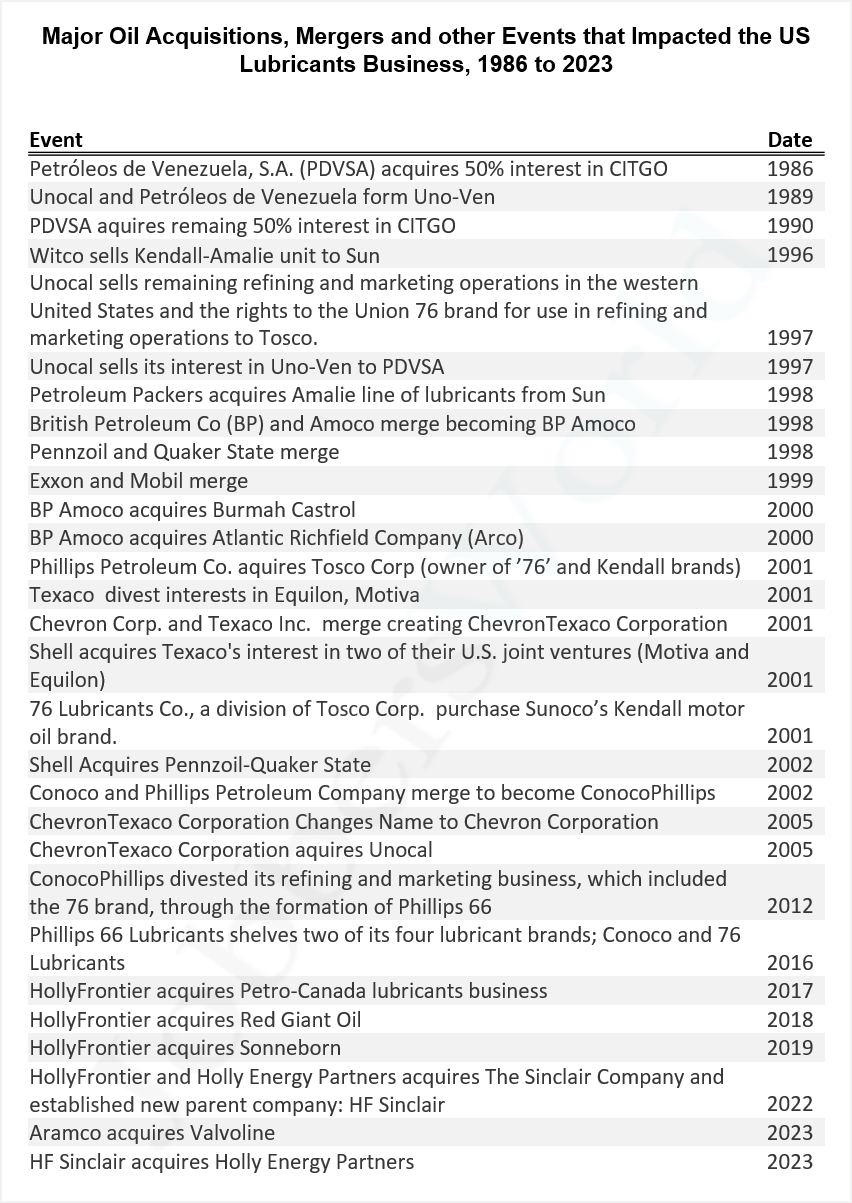
Mergers among the majors drove a rapid transformation in the number of lubricant distributors in the market. Although the motivation for mergers and acquisitions among the majors varies by company, the reasons are generally related to the need to increase efficiency, reduce costs, attain economies of scale and synergies, and to ultimately maximize profits.
While most majors-maintained networks of 300-500 lubricant distributors prior to the megamergers in the 1990s, the combined companies rationalized the number of distributors they did direct business with. This was due to geographic overlap, brand conflicts, and the need to improve efficiency and reducing channel costs, among others.
Within a few years the leading majors culled their stable of authorized distributor back down to what they had prior to the M&A activity. And it didn’t stop there. The leading majors continued to reduce the number of distributors they did direct business with by moving away from small “mom and pop” distributors in favor of those that were aligned, professionally managed, profitable and growing. Today, the largest majors are doing direct business with less than 100 distributors and ExxonMobil has fewer than 50.
Although many lubricant distributors that lost major brands survived the cuts by taking on other brands, others were acquired by the competition or exited the business.
In addition to the influence of the majors reducing the ranks of distributors, lubricant distribution got the attention of private equity firms for its value-generating potential. This helped to rapidly accelerate consolidation and gave birth to some of the largest lubricant distributors in the world.
Industry rollups, the process of acquiring and merging multiple smaller businesses, is a common private equity strategy to grow value. Crowded, highly fragmented industries are typically considered fertile and lucrative ground for roll-ups and with nearly 8,500 lubricant distributors in the US market circa 2000, and majors pushing for alignment, the kinetics of lubricant distribution fit the bill.
Importantly, the end goal of a roll-up strategy is to buy-and-build a company of much greater value than the sum of its parts, and then exit and cash in on the higher value asset. The most common exit paths include an Initial public offering (IPO), a trade sale (usually to a company operating in the same industry), or a secondary buyout by another private equity investor. While PE firms historically held portfolio companies for three to seven years before exiting, hold periods are extending due to the higher interest rates and the more challenging financing environment seen over recent years.
The following are examples of how private equity helped give rise to two of the largest titans in lubricant distribution.
RelaDyne
RelaDyne is a behemoth in lubricant distribution. Since its inception in 2008, RelaDyne has rapidly grown to become the nation’s largest lubricant distributor and market leader in fuel, diesel exhaust fluid (DEF), and reliability services for industrial, commercial, and automotive businesses in North America. The company’s stellar growth came by way of a variety of initiatives, including 56 acquisitions in the distribution channel to further expand in targeted geographies and service-related businesses.
While conceived in 2008, RelaDyne became a reality when, on November 4, 2010, the international private equity investment firm AEA Investors LP, brought together a platform of four successful businesses in fuel, lubrication supply, distribution, and/or industrial services, namely: Mid-Town Petroleum, Inc. (Bridgeview, Illinois); Oil Distributing Company (Cincinnati, Ohio); The Hurt Company, Inc. (Houston, Texas), and Pumpelly Oil Company (Sulphur, Louisiana). RelaDyne also benefited from an exclusive relationship with Mansfield Oil and the support of its business building partner, Kidd & Company, LLC, who originally conceived the RelaDyne concept. In July 2016, Audax Private Equity (“Audax”) announced that had partnered with management to acquire RelaDyne from AEA Investors. Then in December 2021, Audax Private Equity (“Audax”) sold RelaDyne to American Industrial Partners (“AIP”).
The combination of the four platform companies formed RelaDyne, and since then, RelaDyne has continued to actively expand its footprint across the United States with numerous bolt-on acquisitions, as shown below:

RelaDyne is now the market leader in providing the necessary products and services to help companies achieve “best-in-class” equipment reliability performance levels and a greater return on commercial and industrial equipment assets, which is vital to their business profitability and success. “In addition to the company’s established distribution network and customer service capabilities, RelaDyne will distinguish itself from competitors with a focus on value-added services,” said RelaDyne Chief Executive Officer Larry Stoddard. The RelaDyne Reliability Services group (RRS) offerings are organized as an integrated group of services within the company that provide customers with a suite of comprehensive solutions to improve equipment up-time, production output and bottom-line profitability in addition to traditional services of bulk lube and fuel delivery.
Acquisitions are an important part of the RelaDyne strategy and RelaDyne continues to be the “Acquirer of Choice” in the lubricants, fuel, and reliability services industry. It is important to note that many the companies acquired by RelaDyne were also enjoying growth through acquisitions prior to becoming a RelaDyne company. One example is seen with Sun Coast Resources. Sun Coast acquired Southern Lubricants, Ada Resources, and H&W Petroleum, prior to being acquired by RelaDyne.
It is also important to note that this last year RelaDyne expanded for the first time with facilities and an acquisition outside of the continental U.S. with its acquisition of Lucalza (LCZ) based in Guatemala. LCZ was already the largest Chevron distributor outside of the US and with this partnership is looking to continue to expand its presence both within its footprint of five countries in Central America as well as potential new countries and territory. RelaDyne is focused on adding new geography, new capabilities and more density within its current footprint as the company continues to create a national distribution platform.
RelaDyne is Chevron’s largest distributor, and the company also markets other brands, including Shell, Phillips 66, Valvoline, Petro-Canada and others. In addition, RelaDyne owns and markets three nationally recognized private label brands; DuraMAX, Drydene and RelaTECH.
- DuraMAX: The DuraMAX brand includes full synthetic, high mileage, and synthetic blend motor oils, antifreeze, filters, wiper blades, brake cleaners, power steering fluids, and more. Based on a survey conducted by National Oil & Lube News, DuraMAX has been ranked the number one best-selling motor oil blends brand since 2018 by Quick Lube Owners. And on October 3, 2022, RelaDyne announced that DuraMAX, will supply oil to Take 5 Oil Change®’s network of over 750 company-operated and franchised locations across the U.S.
- Drydene: Acquired by RelaDyne in September 2021, Drydene, a brand with a strong heavy duty and industrial products heritage dating back to the mid 1940’s, was relaunched by PPC Lubricants as Drydene Performance Products in 2017. Drydene has since grown to become a recognized national brand with distribution across the country and a complete line of automotive, commercial, and industrial lubricants, including engine oils, diesel exhaust fluid (DEF), transmission fluids, grease, hydraulic and gear oils, racing oils, and metalworking fluids.
- RelaTECH: The RelaTECH brand products are designed to extend the operating life of mission-critical equipment, reduce downtime, and increase productivity across industrial sectors. And the RelaTECH custom blending facility blends, packages and distributes automotive, industrial and metalworking lubricants.
While there is no question that RelaDyne is a titan in lubricants distribution, and the company put a tremendous amount of work in to get there, the story doesn’t end here. There will likely be more acquisitions to come, and many in the industry wonder, how and when will AIP exits the business. And when they do, how will this event impact the landscape of lubricant distribution.
Brenntag
Brenntag is the global market leader in chemicals and ingredients distribution. Headquartered in Essen, Germany, the company has more than 17,500 employees worldwide and operates a network of more than 600 sites in 72 countries. Its two global divisions, Brenntag Essentials, and Brenntag Specialties, provide a full-line portfolio of industrial and specialty chemicals and ingredients as well as tailor-made application, marketing and supply chain solutions, technical and formulation support, comprehensive regulatory know-how, and digital solutions for a wide range of industries. Brenntag finished lubricants portfolio resides in the Brenntag Essentials division.
Brenntag manages its business through four geographically structured segments including, EMEA, North America, Latin America, and Asia Pacific.
As one of Mobil’s largest authorized distributors, Brenntag’s Lubricants division is a market leader in distributing finished lubricants and ancillary products to the automotive, commercial, and industrial business segments and a distributor of many of the major OEM brands. In addition to lubricants, Brenntag distributes base oils (ExxonMobil, ConocoPhillips (PURE PERFORMANCE®), Motiva (Aramco), and Novvi™), and it’s the exclusive distributor of Infineum Petroleum Additives in North America.
As with RelaDyne, private equity also played an important role in Brenntag’s journey to become a true titan in the US lubricant distribution business. To start, while Brenntag’s roots go back to 1874, and as a stock corporation enjoyed tremendous growth organically and through numerous strategic acquisitions, Bain Capital, a US private equity firm, acquired Brenntag in 2004. Then in a secondary buyout in 2006, BC Partners, a global private investment firm, acquired control of Brenntag for close to $3.3 billion. BC Partners continued to grow the company and expand its network and market shares with nearly 100 strategic acquisitions, including investments in the US lubricant distribution space.
In March 2010, Brenntag went public with trading on the Frankfurt Stock Exchange and BC Partners reportedly made three-times return on its investment in Brenntag after exiting the business.
Brenntag’s interest in the US lubricant market first showed up on the radar in 2012, when the company acquired the assets of Lubrication Services, LLC (LSi), one of North America’s leading multi-regional distributors of lubricants and chemicals. Brenntag’s presence in the US market and interest in expanding its lubricants business became quite evident when it acquired J.A.M. Distributing Company in Houston, G.H. Berlin-Windward in NH, the lubricants business of NOCO in NY, and Mayes County Petroleum Products in Oklahoma in 2015/16. When combined, these acquisitions contributed close to $1 billion in sales and moved Brenntag into the position as the largest lubricant distributor in the US at that time, and provided Brenntag with a strong platform for growth in the consolidating US lubricants business. In addition, it is believed to have made Brenntag the largest distributor of Mobil lubricants in the world.
To fully appreciate how private equity fits into the Brenntag story, it’s also important to understand the story behind G.H. Berlin-Windward, one of Brenntag’s largest acquisitions in the US lubricants business.
Prior to December 2011, when Booth Waltz Enterprises (dba G.H. Berlin) acquired Windward Petroleum, the two companies were competitors. G.H. Berlin, headquartered in East Hartford, Connecticut, was Founded in 1920 and was one of the largest and most well-respected distributors of finished lubricants and ancillary products within the automotive, commercial, and industrial sectors in the region. The company operated facilities in East Hartford, CT, Canterbury, CT, Nashua, NH, St. Johnsbury, VT, and Dover, NJ. As a privately held company, G.H. Berlin successfully grew its business organically and through 27 acquisitions to become a powerhouse in the northeast market. The company marketed the brands of ConocoPhillips, Citgo, Shell, Gulf, Summit and others. And when they acquired Windward, G.H. Berlin added ExxonMobil to its product offerings.
The Windward story is quite different.
Windward Petroleum was one of the first and largest private equity rollups in the lubricant distribution space. The company was cofounded by Mike Spoor and John D. Doehring (formerly with ExxonMobil) in 1998 with funding from the private equity group of Halpern, Denny & Co., and later nearly $15 million of mezzanine funding from the private equity group of Brown Brothers Harriman & Co, who later took control of the company. The firm’s vision was to build a lubricants company through acquisitions that had unprecedented scale. And by doing so, create a company with a distinctly different offering to its customers, suppliers, employees and investors. In addition to marketing the Exxon, Mobil, Citgo, Shell, Pennzoil, Quaker State, Kendall, Castrol, and Texaco brands, Windward marketed its own private label lubricant under the NaviGuard trade name.
Bailey Distributing was among Windward’s first acquisitions and the platform to build. Another 17 acquisitions followed including lubricant distributors from Maine to Florida. In the process, Winward grew to become one of the largest lubricant distributors in the US, at that time.
But Windward may have grown too fast leading up to the challenging economic times of the Great Recession (2007 to 2009). The company was struggling and as a result, in 2011 Brown Brothers Harriman divested non-strategic assets in the South and refocused its efforts in the Northeastern markets. In addition, as the business downsized there were a number of changes in their senior management team. But to the credit of Brown Brothers Harriman, they did what they had to do to maintain Windward’s presence in the market before exiting the space by way of a trade sale to G.H. Berlin in 2011.
So, when Brenntag acquired G.H. Berlin for approximately $185 million, they got what had once been 45 independent lubricant distributors. And when J.A.M., NOCO, Mayes County Petroleum, Reeder, B&M Oil, Lubrication Services, LLC and others are included in the fold, it’s clear to see how Brenntag rose to become a titan in the US lubricant distribution business.

April 19, 2024
Moove
Moove is a subsidiary of Cosan S.A., one of Brazil’s largest business groups with investments in energy and logistics and revenue of approximately $23 billion. Cosan started business in 1936 with the Costa Pinto sugarcane mill in São Paulo and since that time has expanded and diversified by strategically investing in the agribusiness, fuel and natural gas distribution, and lubricants and logistics. Today, Cosan is a non-operational holding company, does not sell any type of commodities.
Cosan entered the fuel and lubricants business in 2008 when it acquired Exxon’s fuel distribution assets in Brazil. In 2013, Moove further expanded its lubricants business when it acquired Comma Oil & Chemicals Limited (based in Kent, England) for approximately $100 million from ExxonMobil (Comma was established in 1965 and later became part of ExxonMobil). In addition to manufacturing and marketing the Comma brand, the company developed and distributed Esso and Mobil branded lubricants and chemicals.
In 2016, Moove acquired the British company Stanbridge Group Limited. With this acquisition, Moove became the exclusive distributor of Mobil lubricants in the UK. In addition, during the same year, Cosan became the exclusive distributor of Mobil products in Spain. In 2017, Moove also acquired WP Group, including Airport Energy. WP Group distributes Mobil lubricants and fuels and is the Authorized Distributor for Mobil lubricants across England & Scotland.
With these acquisitions, Moove grew to become one of the largest producers and distributors of lubricants and base oils in the world and one of ExxonMobil’s biggest sales and marketing distribution partners worldwide. Moove has a presence in 11 countries, including Brazil, United Kingdom, France, Scotland, Portugal, Spain, Argentina, Paraguay, Uruguay, Bolivia, and the United States.
Moove has five manufacturing plants (Brazil, England and USA) with a Combined, production capacity of 3.5 million barrels of oil a year. The company focuses on Mobil-brand lubricant distribution in Brazil, Europe and United States and also on its proprietary brands in Europe and USA.
Moove is the sole manufacturer of Mobil-branded specialty lubricants in Brazil and has the exclusive rights to commercialize Mobil products in Brazil, Argentina, Uruguay, Paraguay and Bolivia. Within Latin America, Moove sells via a network of exclusive distributors and directly to large industrial groups and OEMs. Since 2012, Moove initiated an expansion plan into Europe and now distributes mainly Mobil-branded specialty lubricants focused on industrial clients in the UK, France, Spain, Portugal, and the United States.

Moove Moves into the US Market
Moove entered the US market by acquiring MetroLube, one of the leading ExxonMobil distributors in the NY, NJ metro area. Moove’s most notable advance into the US market, however, came with its acquisition of PetroChoice in May 2022. Prior to this acquisition, PetroChoice had also been working hard to build its lubricant distribution through acquisitions.
- MetroLube
Moove’s presence in the USA was established in December 2018 when Cosan Lubes Investments Limited (CLI) acquired Commercial Lubricants, LLC (d/b/a Metrolube). MetroLube is a leading ExxonMobil distributor in the New York and New Jersey metropolitan area.
- PetroChoice
PetroChoice has its roots in Tri-County Petroleum (TCP). Founded in 1969, TCP was initially a heating oil distributor. In 1976, however, TCP made the decision to focus on the commercial and industrial lubricants business and a year later built a lubricant distribution facility in Riddlesburg, PA.
TCP formed a strategic alliance with ExxonMobil in 1993 and received the ExxonMobil Area of Best Efforts designation in the Mid-Atlantic region. And between 1995 and 2004, TCP made seven acquisitions in the Mid-Atlantic Region, including six ExxonMobil distributors and one ConocoPhillips distributor.
TCP’s success, position in the market, and growth strategy got the attention of KRG Capital Partners, a Denver-based private equity investment firm, who at that time was looking for a platform company to build on with further acquisitions in the fragmented lubricants space. With that, KRG Capital Partners acquired Tri-County Petroleum in January 2008. Shortly after, Golub Capital announced that it provided $23.8 million of senior debt, subordinated debt and co-investment equity in support of KRG Capital Partners’ acquisition of Tri-County Petroleum. In the year following the acquisition, TCP’s name was changed to PetroChoice.
On January 17, 2012, in a secondary buyout, Greenbriar Equity Group acquired PetroChoice from KRG Capital Partners. Greenbriar is private equity firm with a focus on the global transportation industry and transportation related manufacturing, and advanced manufacturing. In another change of ownership, on December 1, 2015, private equity firm Golden Gate Capital acquired PetroChoice from Greenbriar. Golden Gate Capital then sold PetroChoice to Moove for $479 million in May 2022.
Headquartered in King of Prussia, Pennsylvania, PetroChoice has grown to become one of the largest distributors and manufacturer of value-added lubricant solutions in the United States, delivering approximately 65 million gallons annually to the industrial, commercial, and passenger vehicle customer segments. PetroChoice has an extensive and high-quality product offering including Mobil lubricants, as well a proprietary line of premium products under the brands Medallion Plus, Dyna-Plex 21C and Eco Ultra. Headquartered in King of Prussia, Pennsylvania, PetroChoice operates more than 50 strategically located distribution centers across 25 states.
While PetroChoice has grown organically, a large part of the growth has come through the acquisition of 19 lubricant distributors during the time the company was owned by private equity. In addition, Tri-County Petroleum acquired seven lubricant distributors before the sale to provide equity and the name change to PetroChoice.

Moove’s acquisition of PetroChoice quickly catapulted Moove into becoming a true Titan in the US lubricant distribution business.
As a lubricant focused company, equipped with robust assets, unique culture, and high-performance teams, Moove significantly strengthens its global presence as one of the largest lubricants companies and a leading ExxonMobil lubricants distributor.